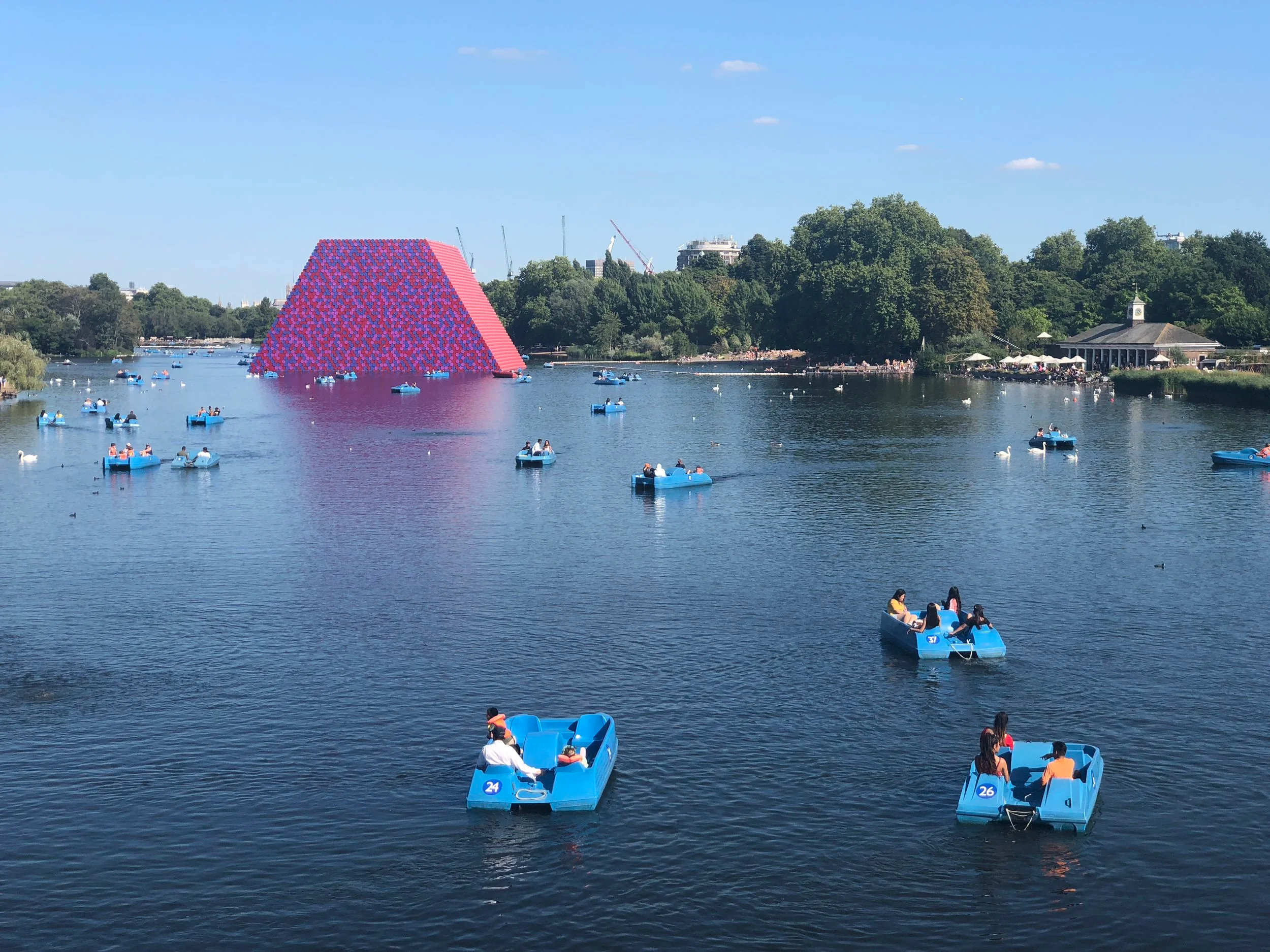
Christo and Jean Claude, The London Mastaba, Serpentine Lake, Hyde Park, 2016-18
What makes public art good? It's such a deceptively simple question.
Is it an artwork people like? Something beautiful? Something impressive? Something that becomes a landmark?
Sometimes, but at its core, we believe good public art is responsive.
It responds to the place it occupies and the people who experience it. It considers what has come before, while also looking at what is being created for the future. It works in conversation with architecture, landscape and community, adding something that feels considered, relevant and connected.
Good public art starts with understanding place
Before asking “What should the artwork be?”, we need to understand where it is going and why it is there.
Every site has layers: its architecture, landscape, materials, scale and movement; its history, culture, community and identity; and its future - who will live or work there, how they will move through it and what kind of place the development is trying to create.
This is where a Public Art Strategy becomes important.
Research might consider First Nations connections to Country, local history and culture, architecture and landscape, important views and gathering spaces, materials, community, council requirements and the broader project vision.
From that research, we can start asking better questions.
What kind of art could contribute to the landscape? Could seating, lighting or an architectural element become an artwork? Could art reveal something about the site's history, encourage interaction or transform an overlooked space?
The strategy gives us the opportunity to explore.
Anish Kapoor's Cloud Gate in Chicago demonstrates how many of these considerations can come together. Its scale responds to its prominent setting within Millennium Park, while its mirrored surface captures the surrounding architecture, sky, weather and movement. There is no single front: people approach it from every direction, move underneath it, touch it and see themselves reflected within it.
The artwork responds to its surroundings, and, in turn, both the place and the people experiencing it become part of the work.
Strategy creates a shared direction
A development has many stakeholders, each looking at the project differently.
The developer may be considering identity, value and legacy. The architect is thinking about form and materiality. The landscape architect understands movement through external public spaces. Council brings planning and cultural objectives, while community and cultural stakeholders may hold knowledge of place that isn't visible in architectural drawings.
A Public Art Strategy brings these perspectives into the conversation early.
Rather than asking stakeholders whether they like a particular artwork, we can have a much more useful conversation about what the art should achieve.
It also allows practical considerations to be addressed: scale, sightlines, materials, weather, access, engineering, maintenance and installation.
Christo and Jeanne-Claude's The London Mastaba is an extraordinary example of why this matters. The temporary 20-metre-high artwork transformed the Serpentine Lake, but its visual impact relied on a clear understanding of the landscape - changing light, views, movement and the way people experienced the space. The lake's ecology also informed the engineering and installation, ensuring a work of this scale could exist safely within the site while minimising its impact on the environment.
It demonstrates that responsiveness isn't only cultural or creative. It can also be environmental, spatial, technical and experiential.
Public art can add cultural value without telling a literal story
Developments inevitably change places. New buildings alter skylines, streets, movement and the way communities experience an area.
Public art gives a development an opportunity to contribute something cultural to that change.
That might mean reflecting something unique about a place, supporting an artist to create new work, giving visibility to stories or perspectives, creating opportunities for gathering and play, or simply making a public space distinctive and memorable.
At its best, public art can anchor a sense of place - strengthening the connection between people, culture and their environment.
But being responsive doesn't mean every artwork needs to tell the history of its site.
Louise Bourgeois' Maman carries its own meaning and history with it. The monumental spider grew from Bourgeois' memories of her mother and explores ideas of motherhood, protection, strength and fragility.
As the work moves between locations, those ideas remain, but its relationship with each place changes. Outside the Guggenheim Bilbao, its enormous scale holds its own against Frank Gehry's architecture, while its slender legs allow people to move underneath and around it.
The artwork alters the experience of the space it occupies, while the space changes how the artwork itself is perceived.
This opens another pathway for public art strategy. The right response isn't always an artwork that tells the story of a site. It may be identifying an existing work, or an artist whose practice can bring something new to the experience of that place.
Good public art should work before you've read the plaque.
So, what makes good public art?
There isn't a formula, but there is a process.
Research the place: its people, community, history, culture and context.
Understand the opportunity.
Respond with a clear strategy and curatorial framework.
The strategy brings together what we have learned about the place, its people and culture, the built environment and the broader project objectives.
The curatorial framework then translates that understanding into a creative direction, identifying where art can make the most meaningful contribution, what it could achieve and the principles that will guide artist selection and commissioning.
Then the artist can do what they do best: respond creatively.
Because the strongest public art isn't simply something beautiful that has been placed within a development, it is something that could only have come from understanding that specific place.
At August Art Advisory, we develop public art strategies that bring together research, curatorial thinking and an understanding of the built environment to identify where art can make a meaningful contribution to a project.
Are you at the start of this process, and want a second opinion before you commit to anything?
Get in touch today - we're happy to answer questions before you've even engaged us.